There was a time when the fear surrounding political speech in Ghana belonged almost exclusively to journalists, opposition politicians, and dissidents. The ordinary citizen could listen to politics from a distance. Power and public expression largely existed inside identifiable institutions: newspaper houses, radio stations, party headquarters, lecture halls, and activist movements. The state knew where speech lived. That Ghana is disappearing. Today, political speech travels through TikTok livestreams, WhatsApp audios, Facebook broadcasts, anonymous accounts, satirical memes, and emotionally charged smartphone videos recorded from bedrooms, roadside kiosks, barbering shops, university hostels, and moving trotros. The distance between citizen and broadcaster has collapsed. Every phone is now a potential media house. Every ordinary individual is potentially visible. Every viral post can become politically consequential. And increasingly, the data suggests, every visible citizen may also become vulnerable. A newly compiled dataset documenting arrests, detentions, and law-enforcement actions linked to public expression between 2018 and 2026 reveals a profound transformation in the relationship between the Ghanaian state and speech itself. The dataset records 46 documented incidents involving acts of public expression. Thirty-five are precisely dated while 11 remain undated due to incomplete archival confirmation. The records were assembled from court files, civil-society documentation, media monitoring archives, police statements, and institutional records, including materials from the Media Foundation for West Africa, Committee to Protect Journalists, and Reporters Without Borders. On its own, the figure may not appear dramatic. Forty-six incidents over nearly a decade does not immediately resemble the machinery of outright authoritarianism. Ghana still holds competitive elections. Radio stations continue to criticize government officials daily. Political parties campaign openly. Courts remain functional. Public debate remains alive. But democratic decline rarely announces itself loudly at the beginning. More often, it emerges quietly through patterns. Through the normalization of interventions that once appeared exceptional. Through the gradual expansion of what states consider dangerous speech. Through the slow migration of fear from institutions into ordinary civic life. And that is precisely what the data begins to reveal.
The New Enforcement Era
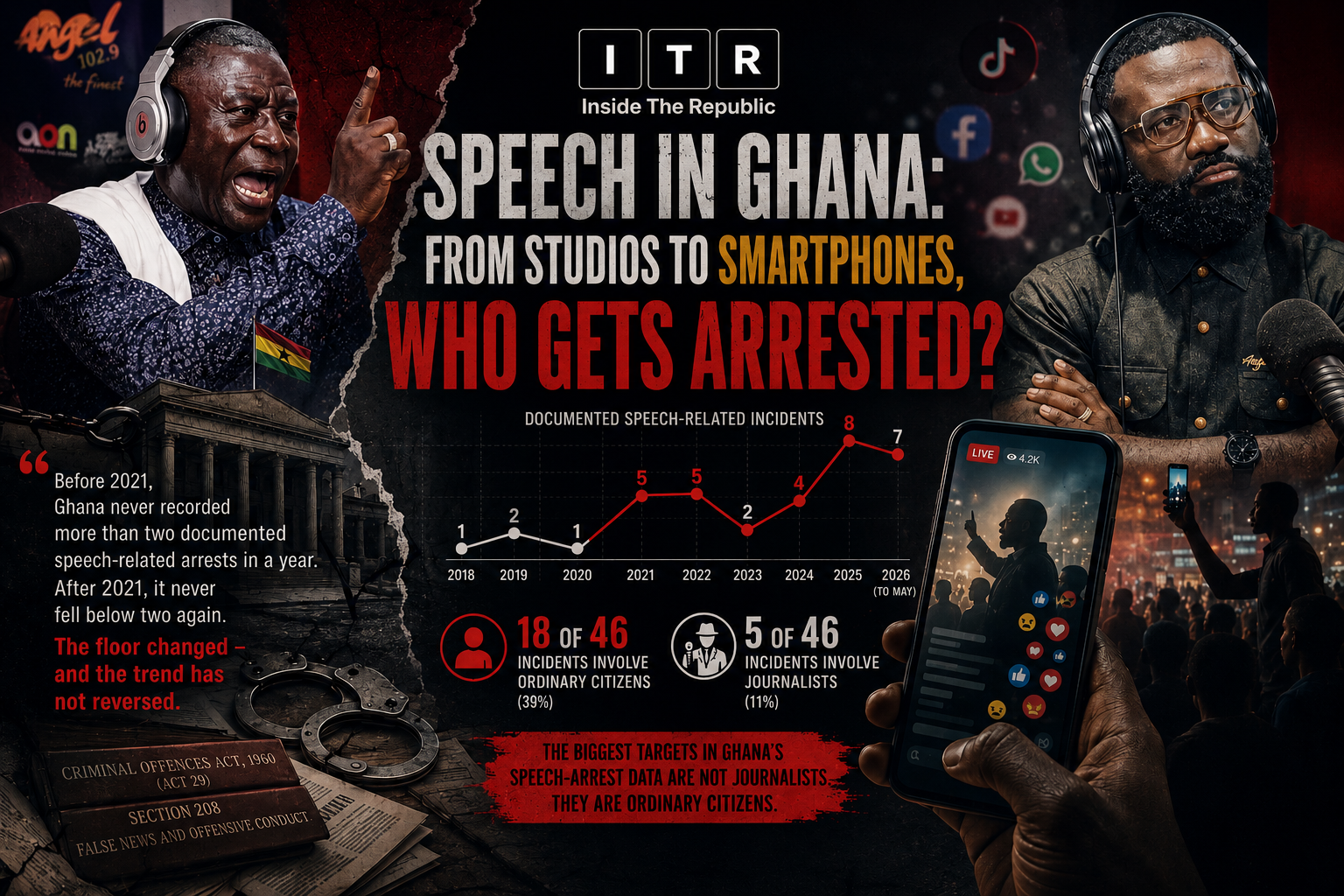
The most important finding in the dataset is not simply that arrests connected to public expression increased. It is that the increase appears structural. From 2018 to 2020, Ghana recorded an average of roughly 1.3 documented speech-related incidents annually. No year exceeded two recorded cases. Then something changed. Beginning in 2021, the baseline rose sharply and never returned to its earlier level. The yearly counts stand at 1, 2, 1, 5, 5, 2, 4, 8, and 7 from 2018 through May 2026 respectively. Between 2021 and 2022, the average rises to five incidents annually. Between 2023 and the first five months of 2026, the average remains above five. In statistical terms, this is not a spike. It is a structural break. Before 2021, the maximum number of incidents in any year was two. After 2021, the minimum number in any year is two. The floor itself permanently shifted upward. That distinction matters because democracies rarely deteriorate through one dramatic event. Political scientists have long observed that democratic erosion usually unfolds through normalization. Practices that once provoked outrage gradually become administratively routine. Citizens adapt psychologically before they fully realize institutions have changed. The Ghanaian public sphere increasingly appears to be entering such a phase. The significance of 2025 is particularly striking. With eight documented incidents, it stands as the highest single year recorded in the dataset. Yet even more revealing is 2026. By May alone, seven incidents had already been documented, placing the year on pace to exceed the previous record if current trends continue. The escalation is not plateauing. It is accelerating. Historically, Ghana’s democratic identity was partly built on the idea that the country had moved beyond the coercive speech traditions associated with earlier political periods. Under Kwame Nkrumah, the Preventive Detention Act became synonymous with state anxiety toward opposition and uncontrolled narratives. Military governments that followed often treated broadcasting and journalism as matters of state containment rather than democratic participation. The Fourth Republic was intended to break from that inheritance. The repeal of criminal libel in 2001 under John Agyekum Kufuor was internationally celebrated because it symbolized a republic choosing tolerance over criminal punishment as the preferred response to contentious speech. But the dataset suggests that while old forms of censorship declined, a newer architecture of enforcement may quietly be emerging in their place.Not necessarily through newspaper bans or formal censorship decrees, but through arrests, detentions, investigations, digital monitoring, and the expanding criminalization of controversial expression itself.
From Radio Stations to Smartphones
The second transformation revealed by the dataset is technological, but its implications are deeply political. For decades, radio defined Ghanaian political life. FM stations shaped public opinion, mobilized partisan loyalties, exposed scandals, and created one of Africa’s most vibrant democratic talk cultures. In many parts of the country, radio still remains the dominant political medium. The early years of the dataset reflect this reality. Broadcast media initially dominated the enforcement terrain. Then the center of gravity moved. Social media and digital communication now account for 24 of the 46 documented incidents, representing more than half the entire dataset. By 2025, six out of eight incidents involved digital or social-media expression. The state followed the migration of speech. This is perhaps the defining political transformation of modern Ghanaian democracy. Public influence no longer belongs primarily to institutional actors. It belongs increasingly to whoever can command visibility. A university student with a TikTok account can now shape national debate faster than a newspaper editorial. A Facebook livestream from Kasoa can trigger public outrage before evening news bulletins even begin. An ordinary citizen with a smartphone now possesses communicative power that previously belonged only to radio stations and media houses. That democratization of visibility has profoundly expanded public participation. But it has also expanded political vulnerability. The dataset reveals this with startling clarity. The largest affected category is not journalists. It is ordinary citizens and public figures, who account for 18 of the 46 documented incidents, representing 39 percent of all recorded cases. Journalists account for only five incidents. That statistic changes the entire meaning of the story. This is no longer simply about press freedom in the traditional sense. It is increasingly about civic speech itself. The criminalization of expression appears to be migrating away from elite institutional actors and into the everyday architecture of public participation. And perhaps no development captures that shift more vividly than the emergence of content creators as an entirely new enforcement category. Before 2025, the dataset records no creator-related incidents. Then the category appears abruptly. TikTok creators emerge among those detained or investigated, including figures linked to viral livestreams surrounding a military helicopter crash. Another creator-linked case appears within the undated records involving a seven-month sentence. This is historically significant. The Ghanaian state is no longer dealing only with journalists, broadcasters, or organized political activists. It is now confronting algorithmic personalities, decentralized audiences, satirical creators, livestream culture, and digital virality itself. In many democracies, this is precisely where the struggle over speech eventually intensifies. Because unlike newspapers or radio stations, digital creators operate outside traditional editorial systems. They are emotionally immediate, difficult to regulate, and capable of reaching mass audiences without institutional mediation. States across the world have struggled to adapt to this reality. In India, Turkey, and Uganda, governments increasingly expanded cybercrime laws, misinformation frameworks, and national-security powers in response to digitally amplified speech environments. Ghana is not equivalent to those systems. But democratic decline is rarely measured only at the point of collapse. It is measured in trajectories, institutional habits, and expanding tolerance for coercive intervention. And the trajectory visible here deserves attention.
When Speech Itself Becomes the Offense
Perhaps the most revealing aspect of the dataset lies in the nature of the allegations themselves. Most incidents do not involve violent insurrection, organized sabotage, or attempts to overthrow constitutional order. Instead, the dominant allegations involve false news, misinformation, defamatory publication, offensive conduct, threats, and incitement. Section 208 of Ghana’s Criminal Offences Act appears repeatedly throughout the records. This matters because it means enforcement is increasingly content-based. The central issue is often not how speech was distributed, but what was said. And that creates one of the deepest democratic tensions of the digital age. Modern governments increasingly govern inside emotionally accelerated information ecosystems where viral narratives can destabilize public trust rapidly. False claims spread quickly. Rumors become politically consequential. Satire becomes difficult to distinguish from misinformation. Public outrage can form within minutes. The temptation for states to intervene therefore grows stronger. But liberal democracy has historically survived precisely because it restrains that temptation. From John Stuart Mill onward, democratic theory consistently argued that societies must tolerate even disruptive or uncomfortable speech unless it directly threatens public safety or constitutional order. Free expression was never designed only for agreeable opinions. Its real purpose was to protect contentious speech from the instincts of power. That principle becomes far more difficult in the age of digital virality. Yet it also becomes more important. Because once states increasingly normalize criminal intervention into contested speech environments, citizens begin adapting behaviour long before laws formally change. People grow cautious. Journalists soften commentary. Broadcasters avoid dangerous subjects. Citizens self-censor online. Satire retreats into coded language. Fear becomes ambient rather than explicit. This is how democratic cultures narrow without visibly collapsing. The dataset cannot fully quantify that atmosphere. No dataset can. But the cumulative curve tells a deeper story than the individual incidents alone. It suggests that the relationship between authority and expression in Ghana is changing in ways that are no longer episodic, accidental, or easily dismissible. And perhaps that is the most important warning embedded in the numbers. Not that Ghana has ceased to be democratic. But that the boundaries of acceptable speech appear to be shrinking faster than many citizens yet realize. The danger to democratic freedoms rarely arrives in dramatic form. It seldom begins with shuttered newspapers, outlawed opposition parties, or mass censorship orders. Democracies more often narrow quietly. Through repetition. Through institutional habit. Through the slow normalization of responses that, years earlier, would have seemed exceptional. That is what makes the pattern in this dataset difficult to dismiss. On paper, Ghana remains one of Africa’s most competitive constitutional democracies. Elections are contested. Governments change. Radio stations criticize power with remarkable intensity. Journalists continue to investigate. Citizens still speak, joke, accuse, satirize, and dissent. Yet the data points toward a subtler tension emerging beneath that democratic confidence. The republic that abolished criminal libel in 2001, celebrated constitutional freedoms, and built its political identity around openness now appears increasingly willing to resolve contested speech through criminal processes, security intervention, and detention. The shift is not yet overwhelming. But neither does it appear incidental. The numbers tell a story of movement: a structural rise in speech-related enforcement after 2021, an expansion from institutional media toward ordinary citizens, and a migration from radio studios into smartphones and digital feeds. More revealing still, the law is increasingly intervening not at the margins of violent extremism or insurrection, but inside disputes over words, allegations, satire, misinformation, commentary, and political narrative. History suggests that the deepest democratic questions emerge precisely at such moments. How much discomfort should a democracy tolerate? At what point does protecting public order become managing public speech? And when citizens begin calculating legal risk before political expression, what quietly changes inside a republic? These are no longer theoretical questions in Ghana. The accompanying interactive dashboard invites readers to examine every documented case, trace the patterns, and interrogate the evidence directly. Because data journalism is not an argument for panic, nor a declaration of verdict. It is an invitation to notice patterns while societies still possess the democratic space to debate them. The future of free expression in Ghana may ultimately depend not on whether citizens can still speak, but on whether speaking slowly begins to feel dangerous.