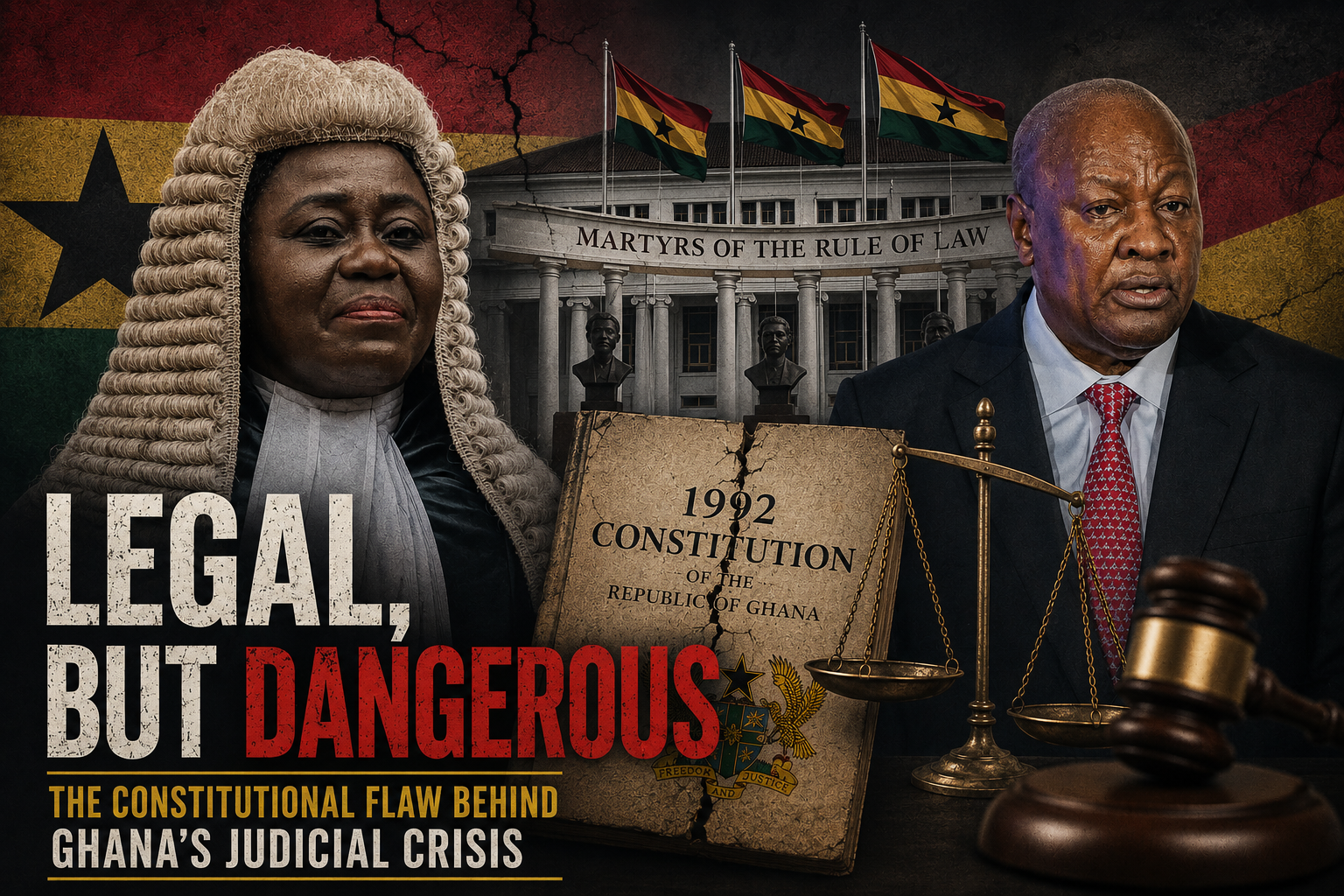
Ghana did not descend into a constitutional crisis on April 22, 2025. At first glance, the events of that day may have invited such a description, especially given the suspension of Chief Justice Gertrude Torkornoo and the immediate political reactions that followed. But a closer reading of what actually transpired suggests something more uncomfortable and more revealing than a breakdown of constitutional order. A constitutional crisis implies dysfunction. It suggests that the rules have failed, that institutions are no longer operating within established boundaries, or that political actors have stepped outside the framework of law. None of that accurately describes what occurred. Instead, what we witnessed was the Constitution being applied as it is written, through processes that are entirely recognised within the 1992 constitutional order. President John Dramani Mahama invoked Article 146, followed the procedural steps required under the Constitution, and triggered an inquiry into allegations that led to the suspension of the Chief Justice. Legally speaking, the process was not only available to him, it was properly activated within the framework of the law. The discomfort, therefore, does not arise from illegality. It arises from something more structural. It arises from the fact that constitutional compliance and democratic comfort are not always the same thing.
The Real Issue Is Not the Actors, but the Architecture
It is tempting in moments like this to reduce the discussion to personalities. Some will focus on the President and question his intentions. Others will focus on the suspended Chief Justice and interrogate the allegations surrounding her office. But neither of these angles fully captures the deeper issue at stake. What happened on April 22 is better understood as a structural outcome rather than a political one. Any President operating within the same constitutional framework would have access to the same powers and the same procedural pathways. That is the point that often gets lost in public debate. The issue, therefore, is not who acted. It is how the system allows such action to be initiated, processed, and concluded. When a constitutional arrangement makes it possible for one arm of government to activate a process that temporarily disables the head of another arm, then the question is no longer about conduct. It becomes a question of design.
Article 146 and the Question of Discretion
Article 146 is often presented as a safeguard for judicial accountability. It is designed to ensure that allegations of misconduct against superior court judges, including the Chief Justice, are not ignored or politicised, but are instead handled through a structured constitutional process. On paper, the provision appears carefully balanced. It involves petitions, consultation, the determination of a prima facie case, and the constitution of an investigative committee. It is procedural, formal, and legally grounded. However, the real concern lies in how much discretion is concentrated at the centre of that process. The President plays a key role in determining whether a petition proceeds to the next stage. The President triggers the suspension. The President also influences the composition of the investigative mechanism. While these steps are framed within constitutional boundaries, they collectively place significant authority within the Executive’s reach in matters that directly affect the leadership of the Judiciary. That is where the tension emerges. The issue is not that the process is illegal. The issue is that it creates a structure where judicial vulnerability is activated through executive discretion, without sufficiently strong buffers of independence or transparency.
The Legacy of the 1992 Constitutional Design
To understand why this is possible, one must return to the political conditions that shaped Ghana’s 1992 Constitution. The Fourth Republic was born out of a desire for stability after years of political disruption and military interventions. The priority at the time was not primarily institutional balance in the abstract sense, but the creation of a system capable of ensuring order and continuity. That historical context is important, because it explains the architecture that followed. The Constitution places significant weight on the Executive, constructing a presidency that sits at the centre of governance and coordinates much of the institutional machinery of the state. Over time, this has produced a system in which Parliament operates with limited structural independence in key areas, oversight institutions often depend on executive-linked appointments, and even constitutionally independent bodies function within frameworks that still reflect executive centrality. The Judiciary is formally independent, but cases such as the suspension of a Chief Justice expose the extent to which that independence is procedurally vulnerable under certain constitutional provisions. This is not an aberration from the system. It is an expression of the system.
A Legal Process That Produces Democratic Unease
One of the most important distinctions that this moment highlights is the difference between legality and democratic legitimacy. A process can be entirely lawful and still raise legitimate questions about institutional balance and public confidence. In this case, the procedures under Article 146 were followed as prescribed. Yet the outcome still generates unease because it reveals how quickly and decisively one branch of government can trigger a process that affects the highest office in another branch, with limited public visibility at key stages. That tension matters because constitutional democracy is not sustained by legality alone. It is sustained by confidence in the fairness, neutrality and balance of institutional processes. Once that confidence is weakened, even lawful actions begin to carry political weight that extends beyond their procedural intent. This is where the deeper concern lies. It is not that the Constitution was violated. It is that the Constitution, as it currently stands, allows for outcomes that test the boundaries of perceived institutional balance.
Why This Is Not About Individuals
It is important to be clear that this moment should not be reduced to a contest between political actors. It is neither a critique of President Mahama as an individual nor a defence or indictment of the suspended Chief Justice as a person. The structural nature of the issue makes such framing inadequate. Any occupant of the presidency, operating under Article 146 as it currently exists, would have access to the same procedural levers. That reality shifts the conversation away from personality and toward institutional design. The concern is not who used the power. The concern is that the power exists in a form that concentrates significant influence within the Executive in matters that directly affect the Judiciary, even if indirectly.
The Question Ghana Must Now Confront
The suspension of a Chief Justice is not a routine administrative occurrence. It is a significant constitutional event that should naturally prompt reflection on the adequacy of the framework that permits it. The question Ghana must now confront is not whether Article 146 was followed correctly. It is whether Article 146, in its current form, achieves the right balance between accountability and independence. A constitutional system can be procedurally sound and still structurally imbalanced. When that happens, the risk is not immediate collapse, but gradual erosion of confidence in institutions that are expected to stand apart from political influence. That is why this moment matters. It forces a reckoning not with constitutional failure, but with constitutional sufficiency.
Conclusion: A Constitution Working, but Raising Hard Questions
What happened on April 22 was not a breakdown of Ghana’s constitutional order. It was the operation of that order under its existing rules. Yet in faithfully following those rules, the system has revealed its deeper tension: a concentration of discretion within the Executive that sits uneasily alongside the principle of judicial independence. That is the paradox at the heart of this moment. The Constitution is not broken. But neither is it beyond scrutiny. And perhaps that is the most important takeaway. A functioning constitutional system is not one that merely operates without violation. It is one that is willing to confront, honestly and repeatedly, the gaps between legality, design, and democratic confidence.