As someone who has worked in Ghana’s media space and closely observed the country’s political developments over the years, one lesson has remained constant: governments are rarely judged solely by what they do in office, but by how those actions are perceived. In Ghana’s political environment, perception is not a soft or secondary layer of governance. It is often the decisive factor that shapes legitimacy, trust, and ultimately political survival. This is why political performance cannot be read only through policy outcomes or economic indicators. It must also be understood through the lens of public interpretation. In many cases, perception becomes the bridge between government action and public acceptance, and when that bridge weakens, even strong performance begins to lose its political value.
Economic Gains and the Reality of Public Expectations
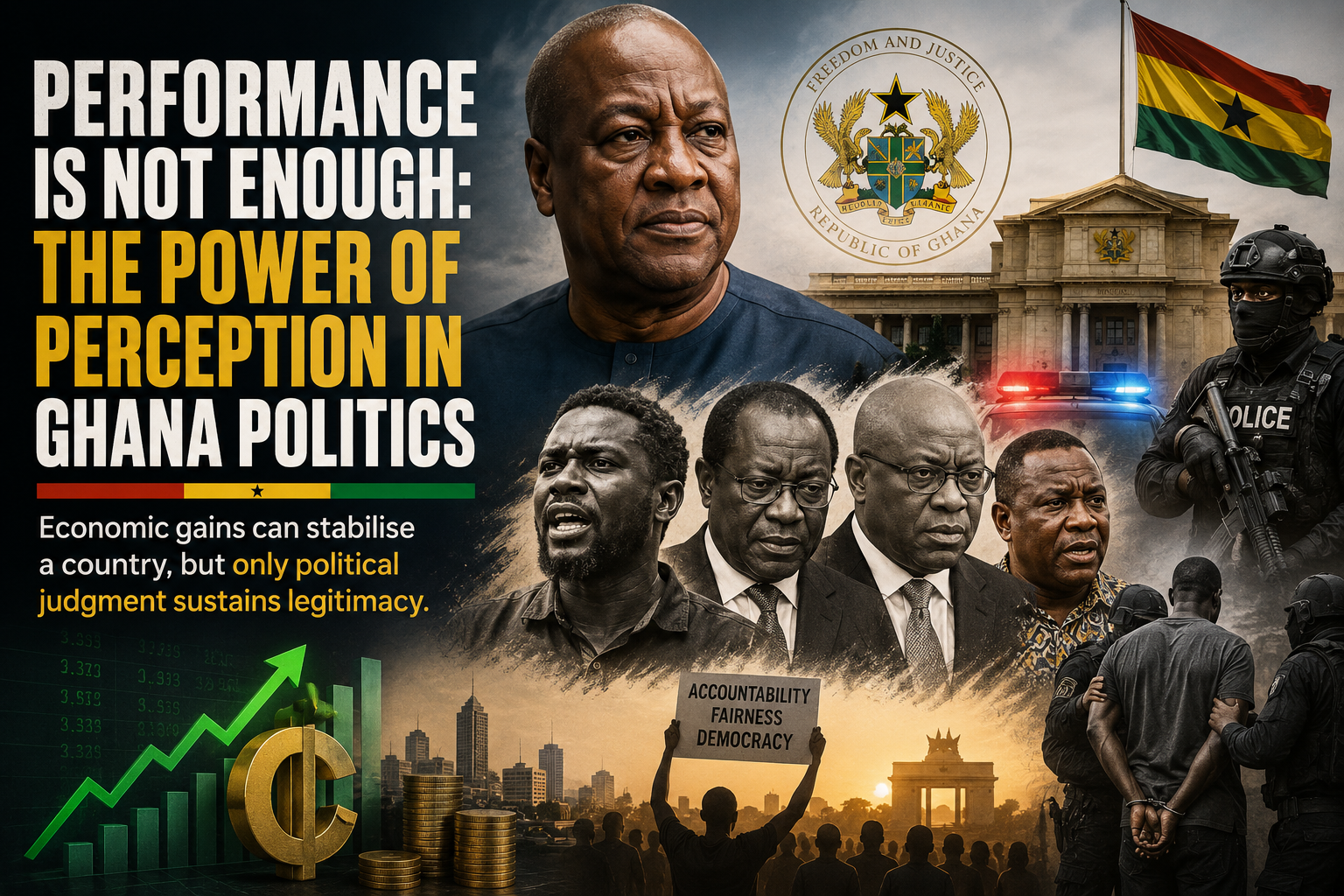
In the early months of 2025, the Mahama administration has recorded a set of economic developments that, by most objective standards, are noteworthy. The cedi has demonstrated relative stability against major foreign currencies, inflation has eased from the pressures of the previous year, and investor sentiment, while still cautious, is showing signs of gradual recovery. These are not minor achievements. They reflect deliberate economic management at a time when expectations were high and public anxiety had not fully subsided from the previous cycle of instability. Any fair assessment must acknowledge that macroeconomic indicators are moving in a direction that suggests some level of control and coordination. However, economic progress does not operate in isolation from political reality. A government may improve key indicators and still struggle to maintain public trust if its broader conduct begins to generate unease. In politics, numbers may stabilise the economy, but they do not automatically stabilise perception.
The Emerging Problem Beneath the Surface
It is at this intersection between performance and perception that the current government begins to face its most delicate challenge. While economic indicators are improving, questions are beginning to emerge about the manner in which state power is being exercised and presented to the public. The recent arrest of Alfred Ababio Kumi, popularly known as Adenta Kumi, is a clear example of how quickly governance actions can move from legal process to political symbolism. Even before legal arguments are fully considered, public reaction is shaped by the imagery of the event itself. The presence of armed officers, early morning operations, and the arrest of a young activist over a social media-related matter created a visual impression that carried its own political weight. In such moments, legal justification alone is often not enough to shape public understanding. Citizens respond first to what they see, and only later to what they are told. That gap between perception and explanation is where political narratives are formed.
A Pattern the Public Is Beginning to Notice
The concern does not rest on a single incident. It becomes more significant when viewed alongside a growing list of enforcement actions involving high-profile individuals. These include former Finance Minister Ken Ofori-Atta, former Bank of Ghana Governor Ernest Addison, and NPP Chairman Bernard Antwi-Boasiako, popularly known as Chairman Wontumi. Each of these cases may have its own legal or investigative basis, and it is not the role of public commentary to prejudge their merits. However, political perception does not evaluate cases individually. It aggregates them. Over time, isolated events begin to form a broader narrative about how state authority is being exercised. That is where the risk lies. Once a pattern begins to take shape in the public imagination, it becomes more powerful than the technical details of each individual case. It begins to influence how citizens interpret future government actions, even before those actions are fully understood.
Power, Restraint, and Democratic Judgment
This is where the discipline of democratic governance is most tested. In any constitutional system, the legality of an action is necessary, but it is not sufficient to guarantee public legitimacy. The exercise of power must also be measured against standards of restraint, proportionality, and public confidence. Political authority is not sustained by law alone. It is sustained by trust in how that law is applied. Governments are therefore judged not only by whether they have the right to act, but also by whether their manner of action strengthens or weakens public confidence in the fairness of the system. This distinction is central to democratic stability. It explains why certain government actions, even when legally justified, can still generate political discomfort if they appear excessive or insufficiently sensitive to public perception.
Lessons from Political Theory and Democratic Practice
Political thought has long recognised this tension between legality and legitimacy. The idea of the social contract, particularly as articulated by John Locke, rests on the assumption that governmental authority is justified only when it preserves public trust and protects citizens from arbitrary exercise of power. Once that trust begins to erode, even gradually, the moral foundation of authority begins to weaken. This does not necessarily mean that the law has been violated. It means that the spirit of democratic governance is under pressure. This is why concerns about political optics should not be dismissed as superficial commentary. Optics are not merely about communication. They are about how governance is experienced by citizens in real time. And in many cases, perception becomes the first and most enduring judgment of political conduct.
The Problem with Historical Deflection
A familiar response in Ghana’s political discourse is to point to previous administrations whenever concerns about state conduct are raised. The argument is that similar actions occurred in the past, and therefore current criticism is either selective or unfair. But this approach does not strengthen democratic accountability. It weakens it. Governance cannot be justified through comparison alone. The fact that something happened before does not automatically validate its repetition. Each administration is responsible for setting and improving standards within its own governing context. Democratic maturity is not measured by how evenly mistakes are distributed across political parties, but by whether each government demonstrates progress in restraint, transparency, and institutional sensitivity.
The Road Ahead for the Mahama Administration
The current administration still has an important opportunity before it. Its economic performance so far provides a strong foundation for broader political stability. But that foundation will only hold if it is matched by careful attention to how power is exercised in practice. The real test of this government is no longer whether it can manage macroeconomic indicators. Early signs suggest that it can. The more important test is whether it understands that legitimacy in a democracy is shaped as much by perception as by performance. This is where political judgment becomes critical. Governments rarely lose public trust in a single moment of failure. They lose it gradually, through patterns of action that begin to shape public interpretation in ways that are left unaddressed. Ghana’s democracy is at a stage where institutions are strong enough to function but still sensitive enough to be shaped by perception. That makes political restraint not just desirable, but essential. If this government is to avoid the familiar trajectory that has weakened previous administrations, it will need to recognise a simple but important truth: economic success may stabilise a country, but only political judgment sustains legitimacy. And in the end, it is not only what a government achieves that defines its legacy, but how those achievements are seen, understood, and remembered by the people it governs.