Accra: On the last day of January 2021, a small office in Osu opened its doors. Inside sat delegates from the European Union, the Australian High Commissioner, and the Danish Ambassador. They came to support an LGBTQQIAAP+ advocacy resource centre. Within hours, Ghana erupted. The National House of Chiefs called the event an abomination. The National Chief Imam denounced it. The Christian Council and the Catholic Bishops Conference joined the chorus. A week later, the centre closed. And a group of Members of Parliament began writing a bill that would become the toughest proposed law against LGBTQ+ activities in West Africa. That bill arrived in 2021 with thunder. It threatened ten years in prison for funding any LGBTQ+ group. It criminalised a person simply for undergoing sex reassignment surgery. It created a sweeping offence called undermining proper human sexual rights and Ghanaian family values, a clause so broad it could have sent a journalist to jail for a critical editorial. Four years later, a new version emerged. The title changed. The date reads 2025. Almost no one noticed what disappeared.
The Morning the Resource Centre Opened
The Osu district of Accra is known for its bustling streets. On 31 January 2021, foreign diplomats gathered at an office there. European Union delegates sat next to the Australian High Commissioner, Gregory Andrews, and the Danish Ambassador, Tom Nørring. Within days, the National House of Chiefs convened an emergency meeting. On 26 February 2021, the Chiefs issued a statement. Ghanaian culture nowhere subscribes to LGBTQI, they said. It is a taboo, inhuman, and alien. In God wisdom, man and woman were created to fulfil procreation. The idea of man marrying man or woman marrying woman is an abomination. Former President John Agyekum Kufour went on Accra FM on 3 March 2021. He said he rejected LGBT legalisation when he was President because it baffled him and defies nature. The late President John Evans Atta Mills, confronted by British Prime Minister David Cameron in 2011, told him that no one has the right to direct other sovereign nations. Mills said he would never support any attempt to legislate homosexuality in Ghana. That was the ground on which the 2021 bill was built.
The 2021 Bill
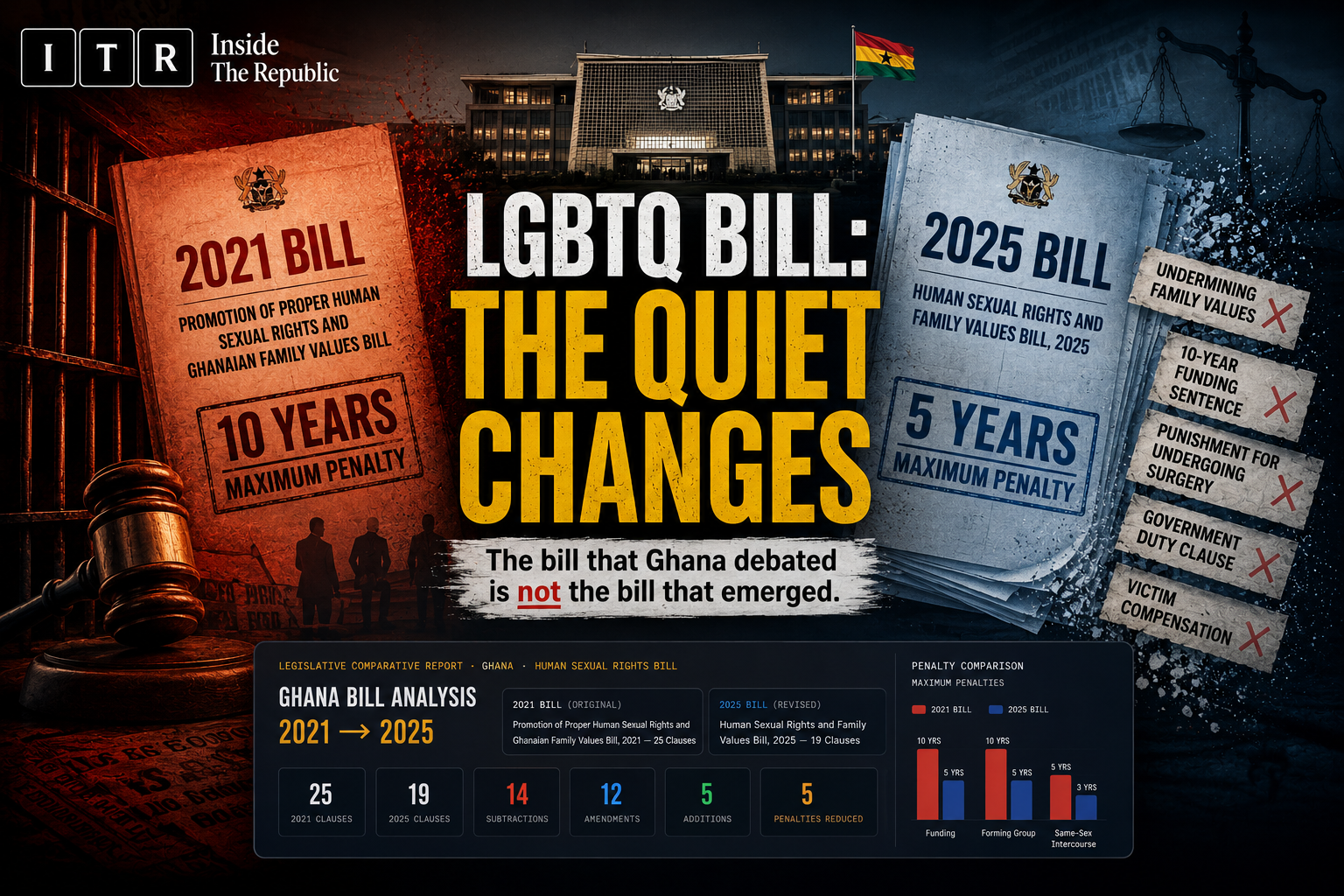
The 2021 bill carried the full weight of that outrage. Its authors named it the Promotion of Proper Human Sexual Rights and Ghanaian Family Values Bill. Its penalties were brutal. Funding or sponsoring a prohibited activity carried ten years in prison. Forming an LGBTQ+ group carried ten years. Same sex intercourse carried three to five years. The bill also made it a crime for a person to undergo sex reassignment surgery, not just to provide it. Clause 4 was the sleeper. It said a person shall not undermine proper human sexual rights and Ghanaian family values, or directly or indirectly instigate, command, counsel, procure, solicit, or purposely aid, facilitate, encourage or promote any act that undermines those values. The penalty was a fine up to 2,000 penalty units or four months in prison. A university lecturer teaching gender studies could have been charged. A newspaper columnist questioning the bill could have been arrested. The bill also created a safety net. Clause 19 said a victim should not be penalised. The court could order compensation for physical or psychological harm. Proceedings for children would be closed. Clause 20 gave an accused person who recanted and requested medical help the right to access it. Clause 21 allowed flexible sentencing. Clause 23 directed the government to provide therapy for questioning persons and assistance for parents of intersex children. That was the 2021 bill. It never passed to become an Act.
The 2025 Bill Arrives
The new bill carries a different title: the Human Sexual Rights and Family Values Bill, 2025. The word Ghanaian is gone. The acronym has shrunk from LGBTQQIAAP+ to LGBTQAP+. The content has changed in ways that lawyers immediately noticed. The maximum penalty for funding fell from ten years to five. Forming a group fell from ten years to five. Same sex intercourse dropped from three to five years down to two months to three years. Detention with intent went from one to five years down to three months to three years. Only one penalty moved upward. Extra judicial treatment, meaning verbal or physical abuse of an accused person, once carried a fine or six months to three years in prison. The 2025 bill removes the fine entirely. A person convicted of mob violence now faces only prison time, three months to three years. The drafters did not announce these reductions. No press release explained why ten years became five.
The Disappearance of Some Clauses
Clause 4 of the 2021 bill is gone. No replacement exists. The offence of undermining proper human sexual rights and Ghanaian family values has vanished before ever reaching a vote. Former parliamentary staff say legal memos warned that clause was too broad. Article 21 of the 1992 Constitution guarantees freedom of speech and expression. The Supreme Court has struck down vague laws before. A clause that could criminalise a private conversation or a newspaper editorial would have faced an immediate challenge. Religious groups initially supported the undermining clause. Some leaders later worried it could be turned against them. A sermon criticising the government could theoretically be reinterpreted as undermining national values. That prospect cooled enthusiasm. The sponsors deleted the clause and said nothing.
The Patient No Longer a Criminal
The 2021 bill made it a crime for a person to undergo sex or gender reassignment surgery. Clause 6, paragraph (g) explicitly listed undergoing as an offence. The penalty was three to five years in prison. The 2025 bill removes that paragraph entirely. Only the provider of such surgery now faces liability. A person who seeks sex reassignment is no longer a criminal under this law. Intersex persons, defined in the 2025 bill as those whose anatomy or chromosomes do not fit traditional male or female markers, appear only as an exception. The word questioning, which described persons exploring their sexuality, disappears from the entire document. A teenager in Ho who wonders about his identity is no longer automatically covered.
The Vanishing Duty of Government
Article 39 of the 1992 Constitution encourages the state to integrate customary values into national life. The 2021 bill imposed a duty to promote proper human sexual rights and Ghanaian family values on the Executive, the Legislature, the Judiciary, the Commission for Human Rights and Administrative Justice, and the National Commission for Civic Education. The 2025 bill removes every single one of those institutions from that duty. Only citizens, parents, guardians, teachers, religious bodies, the media, and the creative arts industry remain. A constitutional lawyer in Accra offered a simple answer. You cannot compel Parliament to promote a specific moral code. You cannot order a judge to preach family values from the bench. The clause was unenforceable. So they cut it.
What Victims Lost
All of the victim protection clauses are gone. Clause 19 on compensation and privacy. Clause 20 on medical help for recanting accused. Clause 21 on flexible sentencing. Clause 23 on therapy for questioning persons and assistance for intersex parents. The 2025 bill does not contain them. A person forced into a same sex act receives no statutory right to compensation. A young person who regrets his actions has no pathway to therapy. A judge cannot order rehabilitation because the law no longer provides for it. The only remaining protection is against mob justice. And that protection now carries no fine, only prison time.
Why the Reductions Are Important
Uganda passed the Anti Homosexuality Act in 2023. That law included the death penalty for aggravated homosexuality. The World Bank suspended new loans. The United States imposed visa restrictions. Nigeria’s Same Sex Marriage Prohibition Act carries a maximum of fourteen years. Kenya’s penal code caps at fourteen years for carnal knowledge against the order of nature. Neither country recently increased penalties. Neither added a sweeping undermining clause. Ghana’s sponsors watched those consequences. They saw the international backlash. They also heard from their own legal advisers. The original ten year maximum for funding was disproportionate. The undermining clause was unconstitutional. The prohibition on undergoing surgery was medically unsound. So they quietly rewrote the bill. They lowered penalties. They deleted the most vulnerable provisions. They removed the duty from government institutions. And they said nothing.
The Bill That Almost Was
The 2021 bill promised a revolution. Ten years for funding. Ten years for forming a group. Prison for the patient who sought sex reassignment. Therapy and compensation for victims. A government duty to promote values from the bench and the cabinet. The 2025 bill delivers something else. Five years maximum for funding. Two months minimum for same sex intercourse. No undermining clause. No punishment for undergoing surgery. No victim compensation. No medical help for recanting. No duty on the Executive, the Judiciary, or Parliament. The resource centre in Osu closed four years ago. The diplomats who attended flew home. The National House of Chiefs issued its statement. The former Presidents spoke their pieces. And the bill that emerged from all that fury is not the bill its authors first wrote. The law shrank. The sponsors never explained why. And the quietest cuts are the ones that matter most.